
LensWork
-
Posts
22 -
Joined
-
Last visited
Content Type
Profiles
Forums
Downloads
Gallery
Store
Everything posted by LensWork
-
Odd, but consistent groups that I can’t explain
LensWork replied to LensWork's topic in Accurizing the .308AR
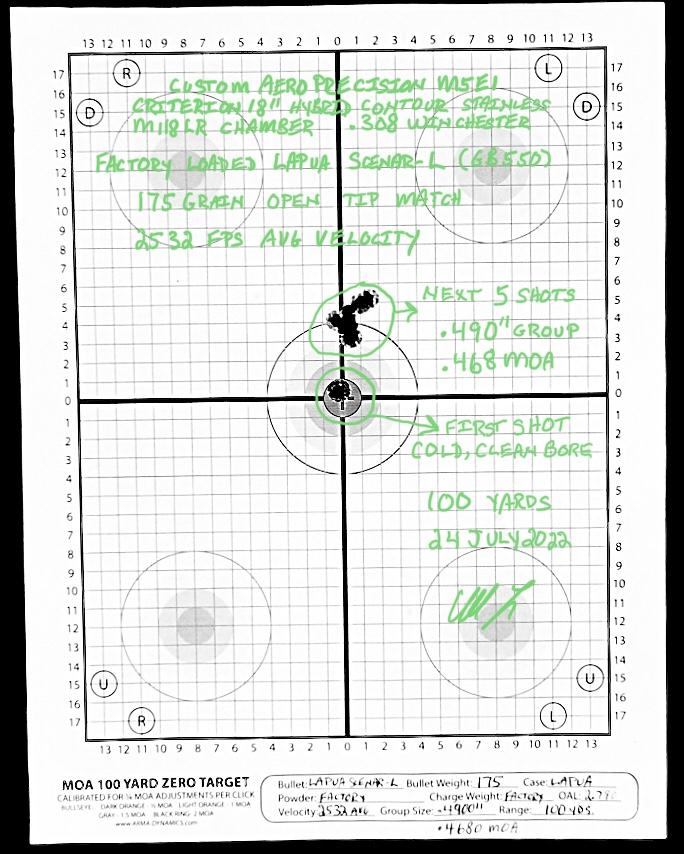
I headed back to the range on Sunday, and using the lesson learned from my qualification set-up, I shot a group that I am quite proud of. I can honestly say that I am not really surprised given all of my previous groups that had three of five rounds in a cloverleaf that measured 0.23” - 0.28” center-to-center. By eliminating the fliers (thanks to those that suggested that I was not being consistent in my set-up), I think that I have wrung the best possible accuracy out of my new rifle. I would have been happy with a 1 MOA gun; so I am thrilled with 0.5 MOA. There is a significant shift in POI between shot 1 — with a cold, clean bore — and subsequent rounds, but the POI remains consistent from shot 2 to shot 20 and beyond.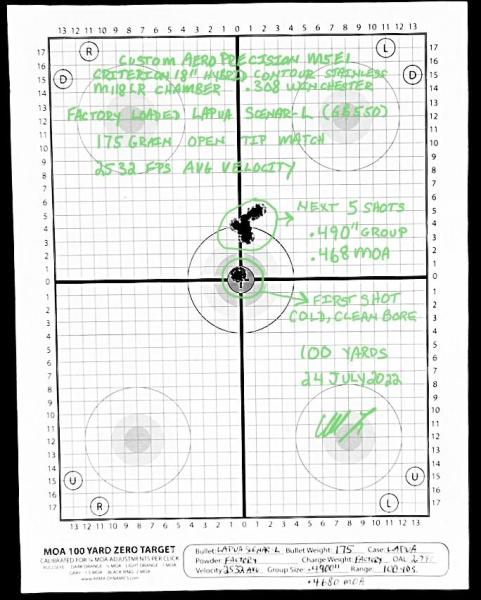
-
Odd, but consistent groups that I can’t explain
LensWork replied to LensWork's topic in Accurizing the .308AR
https://forum.308ar.com/profile/16921-cunuckgaucho/ https://forum.308ar.com/profile/15401-mrmackc/ Thank you very much for the link(s) 😉 I had never shot from a bench prior to building and test firing my M5E1. I had also never used any sort of support, like a bipod or bags. Additionally, I had never shot using a magnified optic before. All of this combined with a nearly 40 year lapse since my Marine Corps days (M16A1, Commando), I think that I relied too much on technology and forgot basic marksmanship. When I first experienced the “fliers”, my initial thought was that the weapon’s recoil was to blame; that the muzzle was rising while the projectile was still traveling down the barrel. I discounted this hypothesis, partly because of the consistency of the groups (3 of 5 shots into a sub 1 MOA cloverleaf, and two high shots), and also because of my inexperience with this type of equipment and style of shooting. I just found it hard to fathom that the combination of supports, total weight of the carbine and — by all reports — a highly effective muzzle device (Precision Armament M4-72), that the weapon would move enough in the ~0.0005 seconds of the bullet’s travel down the barrel to affect POI that much. Boy was I wrong! Once the bag supports were removed for the FWC qualifying, and I was forced to recall, and revert back to the basic principles of good marksmanship, my group size shrank and the “fliers” disappeared. The five rounds that I shot for qualification were the last group that I fired that day, and as of this time, the last group since. I am anxious to get back out to the range, and with the lessons learned, see just what my new .308 AR is truly capable of. -
Odd, but consistent groups that I can’t explain
LensWork replied to LensWork's topic in Accurizing the .308AR
So am I 😉 I just wish I figured it out $400 ago! (~ cost of ammo, range time and gasoline back and forth to the range expended during testing). I just didn’t think that not firmly holding the rifle while pressing the trigger would have that much effect on the POI. I thought that 11# resting on the bags would yield consistent results. Expensive lesson (re)learned. -
Odd, but consistent groups that I can’t explain
LensWork replied to LensWork's topic in Accurizing the .308AR
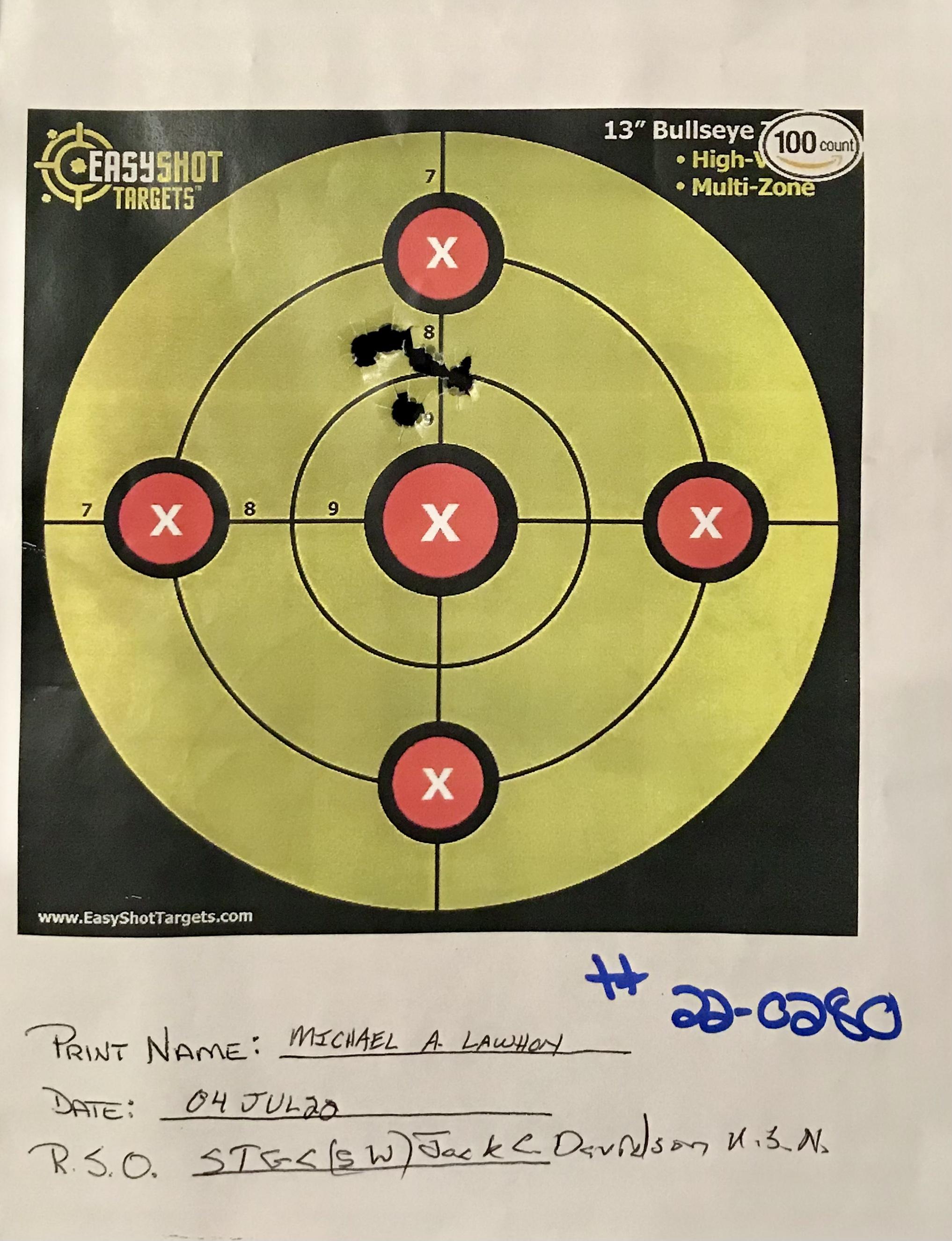
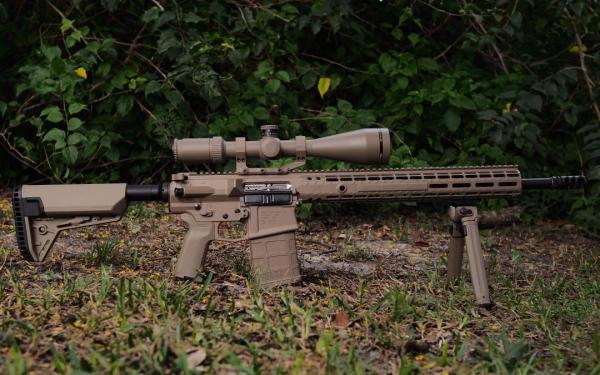
Working on the theory that the issue was related to the feeding of the cartridges, I went back to the range last week and asked my wife to plot the impact locations using a cheap (but for this purpose effective) spotting scope. It was immediately apparent that the “fliers” were inconsistent in each shot string, eliminating the hypothesis that the issue was related to the position(s) of the rounds in the magazine, or a defect on one side of the feedramp.The cause of the fliers was still not apparent until I shot to qualify to use the longer — greater than 100 yards — ranges at my nearby FWC range. In Florida there are a number of ranges scattered around the state operated by the Florida Wildlife Commission (FWC). To shoot on the 200 yard, and longer ranges, you must qualify by shooting five out of five rounds within a 7” target at 100 yards — I know piece of cake 😉. During qualification the only support allowed is a bipod (which although pictured in the initial post, I was not using during the previous range sessions), no other support is allowed.During all my previous range sessions with my new .308 AR, I had been using a Caldwell® AR DeadShot Tactical Bag Set, which consists of a bag for under the handguard and a rear bag that is designed to fit either under an adjustable stock, or flipped over, fits under a fixed rifle stock. Due to recoil, the rear bag would usually need to be repositioned after each round was fired. Also due to the design of the rear bag, and the adjusted length of the MagPul SL-S stock for proper eye relief with my scope, a firm and consistent position of the buttstock within my shoulder pocket and a repeatable cheek weld was difficult to achieve.I believe that this is what lead to the fliers; I say this because during qualification, I shot the best 5-round group that I ever have from my new rifle: 0.79 MOA with Lapua 175gr. Scenar-L factory ammunition. Without relying on the bags, I was able to achieve a firm, consistent shoulder-pocket location and pressure, gripping the front of the magwell, with my thumb wrapped over the top of the handguard, and pulling the rifle into my shoulder, and also a repeatable cheek weld. As a former Marine — qualifying expert with the M-16A1 every year of service — this should have been a no-brainer in diagnosing the cause of the inconsistent grouping, but forty years hence, and a 25 year “vacation” from target shooting, it took longer than it should have to solve the problem.I do thank everyone that offered input and suggestions on the cause of the problem, and how to possibly rectify the issue. Also, though I was aware that recoil starts the instant the bullet begins its travel down the barrel, this experience reinforced that knowledge. The bag set that I was using was great for consistent reticle/target alignment, but since my rifle was basically just laying on the bags, and that during most shots I was not applying any pressure to hold my rifle in-place as I pressed the trigger, the movement under recoil, as slight as it might have been (my M5E1 weighs ~11# as pictured), made a definite, measurable difference in point of impact.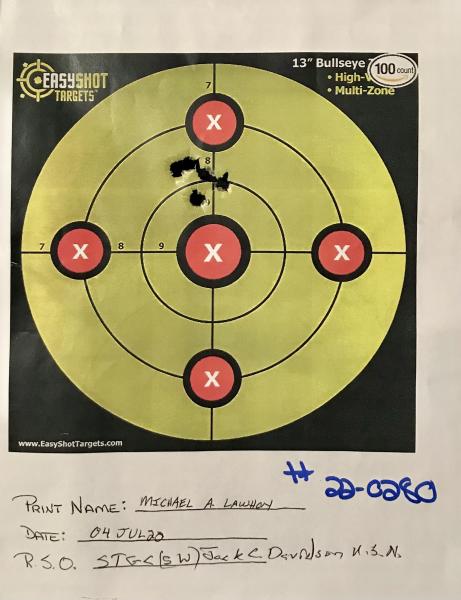
-
Odd, but consistent groups that I can’t explain
LensWork replied to LensWork's topic in Accurizing the .308AR
That is what I thought it could be; I am getting the same results using multiple different magazines, so if it is related to the round being chambered from one side of the magazine, and it’s not the magazine itself, I wonder if it could be the barrel feedramp??? -
I am getting some very odd groups with my new custom Aero Precision M5, in .308 Winchester. With several match grade factory loads at 100 yds., I am getting three rounds of a five round group that are a cloverleaf measuring ~ .25” center-to-center, with the other two rounds high and expanding the overall group to ~ 1”x1”. I have gotten these virtually identical groups with Federal 175 7.62x51 MK HPBT, Nosler 175 Custom Competition, Barnes 168 TTSX and Lapua 175 Scenar-L. The groups are fired semi-auto, magazine fed. The groups have all been fired at about the same pace: one round every 30-60 seconds, so no significant heat-cycling of the barrel. I am getting the same results from multiple different magazines — all Mag-Pul — 10 round, 10 round with -5 round limiter and 25 round M118LR magazines, so I can’t attribute it to a specific magazine. The barrel is a Criterion 18” Hybrid; comp is a Precision Armament M4-72; BCG is JP Low Mass with a JP Enhanced bolt; optic is a Trijicon Credo HX 2.5-15x56mm. I have duplicated the same results on different trips to the range. I am at a loss as to explain how I could be getting 3/5 rounds in essentially one ragged hole and the other two high “flyers”, with multiple different factory loads. Any ideas?
-
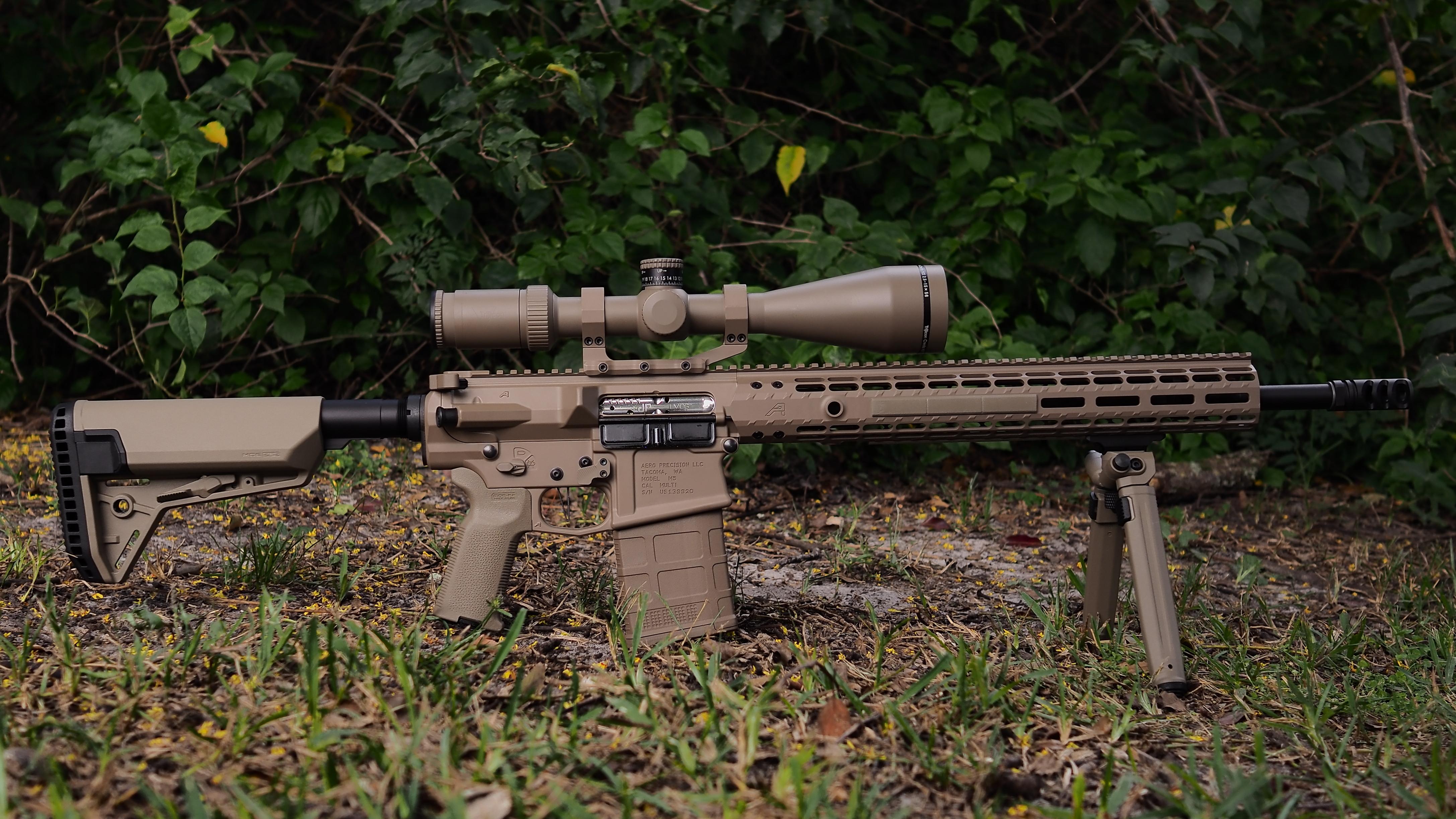
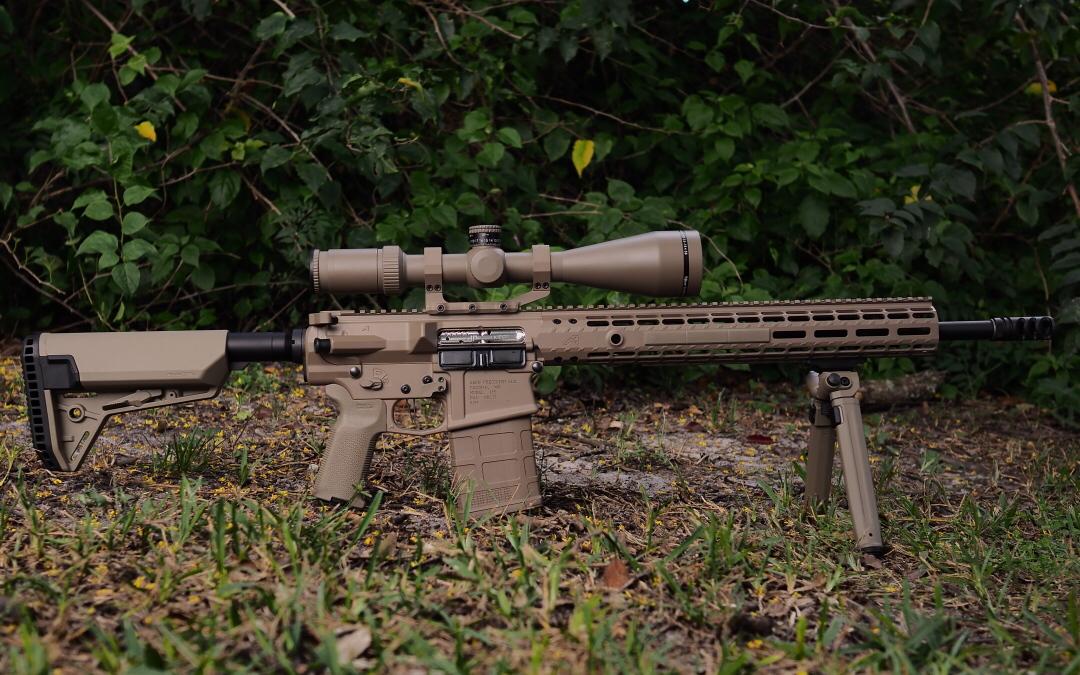
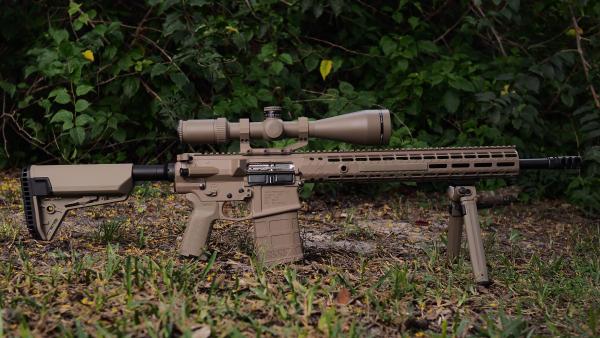
Well it is finally done:
-
Thanks; much appreciated!
-
The ‘smith that built my M5 works for the FFL that I bought the lower from, so I really don’t “know” him, other than by reputation. He built several M5s for the SWAT team of a Central Florida Sheriff’s Office. Given his experience with the idiosyncrasies of the M5 platform, and the $2k investment in parts that I made, the $125 he charged to assemble my rifle I feel was money well spent. I once saw a sign in an automotive repair shop that said something like: Hourly Rate $50 $75 if you watch $100 if you ask questions $200 if you started the work yourself There are so many resources available today (YouTube videos, forums, Facebook groups, manufacturer’s product websites, independent publications tests/reviews) to understand how something works — and what doesn’t work — that with enough time spent doing research, even someone like myself can cobble together parts for a functional weapon. My problem is that I just don’t have the physical skills/capacity to assemble the parts. So much of what makes a good gunsmith/mechanic/etc. is feel/touch. After more than a decade as a competitive IPSC shooter during the ‘80s & ‘90s when the floor for making Major Power Factor was 180, I have lost much of the feeling in my hands as a result of firing at least 500 rounds of .45ACP per week in practice, plus another 200+ rounds in weekly matches. I have had multiple surgeries on both of my hands and wrists, surgery on both shoulders and my neck (thanks to a car accident) and I still have pinched nerves that affect my dexterity. Not everyone can drive a race car, and few drivers can build one, so I try to stay in my lane.
-
I would, but I don’t have the (physical) mechanical aptitude; I never have. My abilities are limited to basic field-stripping for cleaning. I can (could) change the oil in my car, but I would never even attempt to rebuild the engine. My strengths have always been on the research, theory and technical analysis. As someone once said, “a man has to know his limitations”.
-
Received a text from the gunsmith assembling my M5 that the test-fire was flawless and that I can pick it up in the morning. Very excited! My scope should be back from Cerakote in about ten days, then I can take this bad boy out to the range to dial it in.
-
True; hopefully between the adjustable buffer and the adjustable gas block, I will be able to tune the system for reliable, consistent function, hopefully 🙏. I got impatient waiting on the Lantac BCG. Once I got the barrel, the BCG was the last part I needed, and after ten months of acquiring all the parts to build the M5 — beginning with the lower receiver last October. — I was anxious to complete this project. I scored the JP bolt carrier and bolt for such a deal ($226.28 for both), and they were in-stock, so I just couldn’t pass it up. Before I placed my order for the JP components, I ran momentum simulations using the two ounce lighter (16 vs. 18.1) JP carrier, and with the adjustable-weight buffer only, I was able to duplicate the reciprocating values (velocity, time, distance and energy) to within 0.4%. The adjustable gas block should give me an additional factor to compensate for any other variables, such as different ammunition. I know all the calculations are no substitute for actual live-fire testing, but based upon the results of the calculations, I should be close enough that further adjustments of the buffer weight and gas block should result in a reliable weapon. I have been reminded that the window for reliable function of a .308 AR carbine is smaller than that of a rifle length buffer system, and smaller yet than that of an AR-15. Hopefully given the adjustability in the components that I have chosen, I will be able to thread the needle and fit through that small window.
-
I wanted to update any interested parties that graciously contributed their knowledge and experience to guide me in the selection of components for my first AR .308 build. I got tired of waiting on the last couple of parts, namely the barrel and BCG. After having both items on backorder for 3 1/2 months, and multiple estimated delivery dates come and go, and no revised ship date, I was able to snag comparable items that were briefly available before they too were sold out: Barrel: Criterion DPMS Pattern 18″ 308 AR HYBRID, RIFLE GAS, SS, 1-10 T, Nitride Bolt Carrier: JP Low Mass Bolt Carrier - Large-Frame (.308) - Polished Stainless Steel Bolt: JP EnhancedBolt™ with Bolt Assembly Completion Group - .308 , IonBond DLC black The best part is that the substitute parts actually saved me ~$170! Also, I purchased the standard Aero Ultralight scope mount instead of the SPR version in my list at the top of this thread. I found that because of the longer length of the M5 upper — compared to an AR-15 upper — the offset of the SPR mount was not needed. The scope is at Gibbs Guns for application of Cerakote to match the Aero FDE. Once everything is assembled (Gibbs has about a six-week backlog to Cerakote the scope), I will post pictures before I dirty it up dialing everything in.
-
I ended up ordering their (Wilson Combat) AR10 rifle length gas tube with their 18” hunter profile .308 barrel; So I will have an extra AP melonite rifle length gas tube. I am sure that I will find a use for it on another upper build for either my M4E1 or M5. If not, I am only out $15. I am still waiting on the barrel and Lantac BCG. Other than that, the only parts that I don’t already have in-hand, or on-order, is a scope and bipod.
-
I am going to get a different scope mount than the one that I listed at the top of this thread; the Aero mount that I listed I believe is more suited for an AR-15 than an AR .308. I am leaning toward the Wilson Combat V3 Ultralight AR Scope Mount, 30mm https://shopwilsoncombat.com/V3-Ultralight-AR-Scope-Mount-30mm/productinfo/TR-LWM-30/ or the American Defense Manufacturing AD-RECON-S. I am torn between a quick-detach mount and a bolt-on (non-QD) mount. This is going to be a hunting/range rifle, so the need to quickly remove the scope and switch to BUIS in a SHTF scenario does not apply (I have a 14.5” barreled M4E1 with a 1-6X LPVO and BUIS for such an occasion). The bolt-on type mount is a couple of ounces lighter than a QD mount, and not having BUIS saves another ~2.5 oz., total weight savings ~4.5 oz. As they say ounces equals pounds and pounds equals pain, and in my advancing age and with two bad knees, every little bit helps. I would rather spend the weight on the 56mm objective lens version of the scope as opposed to the 42mm version for better low-light target identification. Also I believe that with the bolt-on type mount, especially the Wilson with three cross-bolts, there is less chance of the mount/scope shifting, which at 15X and longer ranges, even the very slightest movement would result in a major shift in POI. It can be said that in a hunting scenario, should something happen to the scope, having BUIS could be the difference between meat on the table and a wasted day. What say you: bolt-on mount or QD with BUIS ? Thank you in advance for your input!
-
From the nokick.com website: “JP Tuned and Polished Extra Power Buffer Spring - 308 Carbine (for collapsible stocks) *Designed for .308/7.62mm AR style carbines with M4 length, 7" deep buffer tubes and 2.5" buffers.” Call me a fool then, but it sounds like there IS another manufacturer that makes a spring for the combination of recoil system parts that I have chosen, and it is the spring that I purchased. I did ask for advice, and I greatly appreciate your time and effort in responding to my questions, but calling someone a fool if they don’t blindly heed your advice (which as I quoted above is apparently not accurate) is not the way to share your obvious wealth of knowledge. So thank you very much for the lesson. Where should I mail the $0.02 check to? If in the (unlikely) event that the JP spring is not correct for the Aero tube and Odin buffer, I’ll make it a check for $20 and get the Sprinco Orange spring. Also, I can understand (to a point) your disdain for Odin labeling their AR large frame carbine buffer as “AR-10”, and technically you are correct, AR-10 is the trade-name of Armalite pattern rifles, which the Odin buffer is not designed for, but however incorrect, “AR-10” is commonly used as a generic term for large frame .308 Winchester based AR type weapons. I can 100% agree that using the generic term “AR-10” when it should properly be labeled as DPMS pattern .308 can lead to those that are obviously less informed than you in selecting the incorrect parts. However, when you use language like: “complete bullshiit”, “total fucking mess”, “fucked that one up, royally”, “Dumbass move”, frankly I question if your statements are that of an informed adult, or the ramblings of a self-centered youngster. I am no snowflake (former Marine and LEO), but when someone espouses their opinions in a public forum in the manner that you have, directed at an individual that they do not know from Adam, it lessens your credibility to me. Thank you again for your input.
-
I did order a Wilson AR-10 rifle length gas tube with the barrel. Their customer service was confusing at best; I asked if their .308 rifle length gas barrels used a standard AR-15 rifle length gas tube or the longer Armalite rifle length gas tube; the reply that I received stated that a standard rifle length gas tube would work, but that they sold a longer rifle length gas tube that worked better. ???
-
First let me apologize for the delay in my reply. It was certainly not my intention to “ghost” (I think that’s what the kids call it these days) those who took the time to offer their insights. The past month has been very difficult, and frankly my AR .308 build has not been at the top of my mind; in-fact I had nearly forgot about it until a box of backordered parts showed up last week. The day after my post and request for assistance (which I greatly appreciate the feedback), I had a close family member pass away, and the day of the funeral another family member was killed in a car accident on the way to the funeral. Then my wife was injured at work, so my energy was devoted to caring for her. Enough with my sob story. The Odin AR-10 adjustable buffer that I chose has an overall length of 2.580”, while the Aero Enhanced buffer tube has an internal depth of 6 15/16” - which matches the Aero “standard” mil-spec tube on my Aero M4E1 build. One reason that I chose the Odin buffer was that I had an extra tungsten weight from the Odin AR-15 adjustable buffer that I purchased when tuning my M4E1. Using both the included tungsten weight from the AR-10 buffer and the spare from the AR-15 buffer, the total weight of the buffer is 5.5 oz. The JP .308 carbine spring has a relaxed length of 11.25”, the same as an AR-15 carbine spring. I referenced heavybuffers.com Slash’s Big Buffer Table when selecting the tube, buffer and spring. It shows that the standard length of an AR-15 carbine buffer is 3.25”. An AR .308 requires ~0.540” longer bolt carrier stroke than a 5.56mm AR-15; so if my math is correct, an AR .308 carbine buffer can be no longer (assuming the use of a standard length carbine buffer tube) than 2.71”, which the Odin at 2.5800” falls below, so theoretically there should not be any issue with “short stroking”. The weight of the Odin buffer (with two tungsten weights) at 5.5 oz. falls right in the middle of the 5.4-5.6 oz. weight of AR-10/CAR-10 carbine buffers, and .1 oz. heavier than the recommended 5.4 oz. H3 AR-15 buffer that “won’t ever have any issues, on a .308 Winchester shooting .308AR build”. I can certainly see where the Odin AR-10 buffer, as it comes packaged, at only 4.65 oz. max could be considered too light. I am hoping that between the adjustable buffer and adjustable gas block, I will be able to tune my build for maximum reliability. I have acquired an assortment of .308/7.62mm ammunition from 150-185 gr. for testing (185 gr. being the heaviest/longest bullet that would be stable in the 1:11.25” twist Wilson barrel) once I receive the last of the parts needed to assemble my rifle.
-
I started another thread in the member build category with my list of parts. It seemed more appropriate to continue the discussion of the specifics of my build there than here in the introductions category. I would greatly appreciate it if those of you that have queried my purpose/expectations of this, my first AR. .308 build, could review my parts list and make any suggestions in the new thread located here:
-
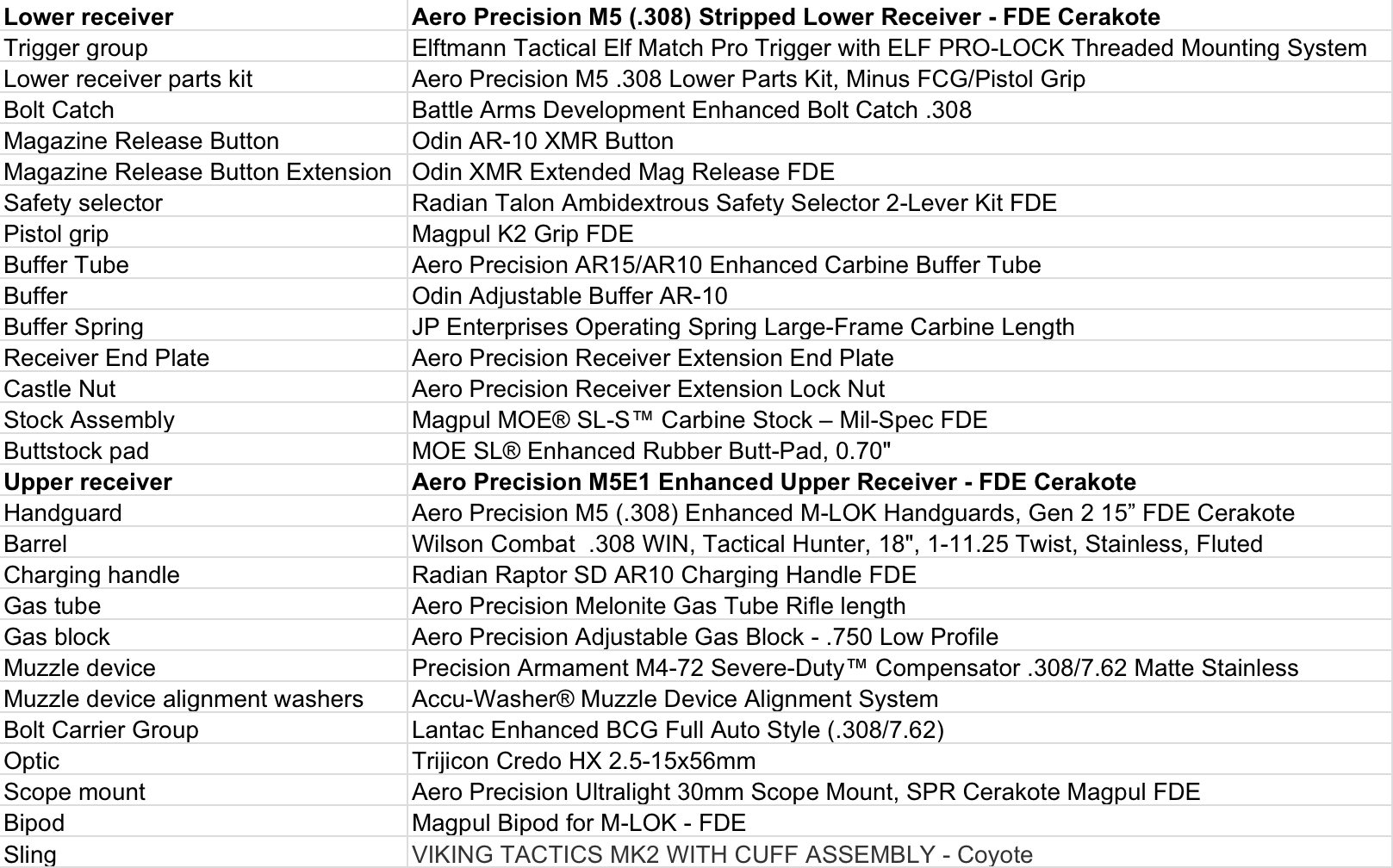
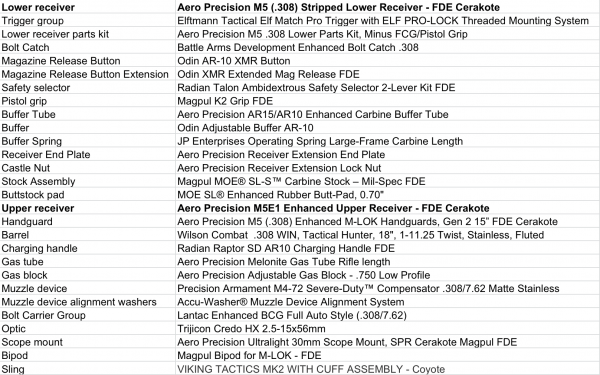
The following is the parts list for my first AR .308 build. I would greatly appreciate it if you could review it and make suggestions for any compatibility issues or substitutes for sub-standard parts. The build is a DPMS pattern carbine, general purpose hunting and target range. I have most of the parts already except for the barrel, BCG, buffer tube, scope and mount, and bipod. Thank you very much for sharing your expertise and time.
-
Thank you very much for all of your kind welcome to the group. I landed on an 18” barrel as there seems to be a precipitous drop-off in velocity (~-50 FPS/inch) with the .308 Winchester (150-175 gr. loads) on barrel lengths any shorter, while there is minimal velocity gains (~+20 FPS/inch) with longer barrel lengths, so 18” seems to be the “sweet spot” of velocity vs. weight/length. There are a couple of facilities within a short drive of me that have 1000 yd. ranges, so that would be the maximum distance I would be able to shoot. With an 18” barrel loads like the M118LR and the Federal GMM 175 gr. SMK remain supersonic to 1,000 yards, while with a 16” barrel the same loads drop below supersonic at less than 950 yards. With regards to hunting, here in Florida the most common game is deer and feral hogs, both of which are usually taken from stands at distances less than 100 yards (actually less than 50 yds.), but I have family in Texas and Wyoming that have land where the hunting is usually spot and stalk where the range, in the case of Wyoming, be several hundred yards for elk. I intend to put a Trijicon 2.5-15X56 scope on the .308; such an optic should offer excellent versatility for both close-in hunting at twilight and reaching out to ring steel at 1,000 yards. As a sports photographer my race-day equipment load was 40+ lbs. for an event like the Daytona 500. I would carry this load for 12+ hours and walk several miles over the course of the day, so a 10-15 lb. rifle would be substantially less than what I was used to. That being said, I was forced into retirement due to health issues including a heart attack, 3 knee surgeries, surgery on my neck and both shoulders (carrying all that gear took its toll), so the lighter the rifle the better, without sacrificing any performance. The Wilson barrel that I mentioned in my first post weighs 38.4 oz, which is almost a half-pound less than the BA barrel that I originally planned on, so BA discontinuing it may be a blessing in disguise. The reviews for the Wilson AR barrels are very positive and report sub-MOA accuracy. I would greatly appreciate any suggestions for other options. Thank you!
-
I found your website while searching for information about .308 barrels. I am a former Marine, LEO and a retired photojournalist - mainly shooting sports, the last 13 years before I retired working as a contractor for Daytona International Speedway. I am in the process of building a .308 AR; I have all of the parts except for the BCG and the barrel. I had planned on using a Ballistic Advantage .308 Fluted Premium Series 18” Heavy Barrel. Unfortunately it appears that BA has discontinued this model. I was on the waitlist at BA and at least a half-dozen BA dealers for the barrel, but BA has removed it from their website recently indicating that they are no longer offering this model. I chose this model because I have a 14.5” version of the same one on my custom Aero Precision M4E1 in .223 Wylde and I have been very pleased with it. So the search for a new barrel is on. I want an 18” barrel as a compromise between a 16” and a 20”. The 18” will give me higher velocity than a 16”, while being lighter in weight and more portable than a 20”. This AR .308 will be an all-purpose rifle for both hunting and long(ish) target range use. I have considered a carbon fiber barrel, but they seem to suffer from vertical stringing when shooting multiple rounds at a relatively quick pace, the same issue that plagues slim barrels. I am also not really excited about spending $600-$900 on a barrel. I am considering the Wilson Combat Tactical Hunter, 18", 1-11.25 Twist, Stainless, Fluted barrel. It appears to have the features that I am wanting, namely a heavy profile but weighing less than 3 lb. Any other suggestions that the group would have will be greatly appreciated. Thank you for allowing me to join the group. I am looking forward to learning more about the .308 AR platform from the group and at some point being able to contribute my experience to the group.