
Lane
-
Posts
1,042 -
Joined
-
Last visited
Content Type
Profiles
Forums
Downloads
Gallery
Store
Everything posted by Lane
-
Lane's: jtallen83 inspired 21.750" 300 AAC Blackouts
Lane replied to Lane's topic in 300 AAC Blackout
So far as I can tell, that's still totally legal. These builds should all land above that 2,000 fps threshold. Might find some nice fossils if planted correctly. -
Lane's: jtallen83 inspired 21.750" 300 AAC Blackouts
Lane replied to Lane's topic in 300 AAC Blackout
Tight butt holes; and nobody looks you in the eye. Everyone checks out your belt region though. They'll call the cops if the see a bulge. Welcome to NY state. -
Lane's: jtallen83 inspired 21.750" 300 AAC Blackouts
Lane replied to Lane's topic in 300 AAC Blackout
I want to; my local gun shop offered to take if for free (usually a $35 fee). Only now; the last few times I've visited, it wasn't a friendly environment. New people, and it's not going well in the back of the store. Again in NY, we can't quite buy online; has to be shipped to an FFL. I wish anyone would try to fix this garbage; but I just reload as a result. I really wanted to buy that 21.5" 1:8 twist GM barrel. I just couldn't justify the shipping when dealing with the rest of this. Is that a necessary accessory in this mix? -
Lane's: jtallen83 inspired 21.750" 300 AAC Blackouts
Lane replied to Lane's topic in 300 AAC Blackout
Or am I wrong again in my calculations? -
Lane's: jtallen83 inspired 21.750" 300 AAC Blackouts
Lane replied to Lane's topic in 300 AAC Blackout
Ah poop. Yes. I wanted that 1:8 barrel made longer. Only Green Mountain wouldn't do that for me in a 21.750" or 24.000" in barrel. Live Free or Die is what they say; but actions speak louder than words. (I've got that live free or die in my blood); it's all good. Just trying to virtually tune my load before I get the barrel. -
Lane's: jtallen83 inspired 21.750" 300 AAC Blackouts
Lane replied to Lane's topic in 300 AAC Blackout
This is why I mentioned some other options. That GMX is lead free, light; and has a good BC? I'm very much looking at accuracy loads; but I can shoot a pure copper projectile at almost anything, and not care about my water supply (that gives me distance testing at home). Been meaning to clarify some erratic questions I posed earlier. Am I looking for pure speed when launching these light projectiles given the small cartridge size? Am I in good shape to shoot for a fast 78 grain if I can find the right load data? Have tons of other calibers/cartridges I can test here now that I have a chrono; it just hasn't been nice enough weather when I have the time. -
Lane's: jtallen83 inspired 21.750" 300 AAC Blackouts
Lane replied to Lane's topic in 300 AAC Blackout
Didn't see a bad word written about them anywhere. The price was right; and they didn't bat an eye at my specifications. So many other custom shops didn't even have 300 AAC Blackout as an option; much less offer length. I've been curious to know what the broader shooting community thinks about modern CNC made barrels vs. what couldn't have been made that way back when the Houston Warehouse was in operation. This would be something like a CD vs. vinyl quality argument in my mind; and I really have no opinion either way. If none of you figured this out yet; the 21.750" is going to be my long term holding (and with great pride). No idea where the rest of the experiments are going to go in the end. If I can't go below 16" by law; one can only guess. Measured the new ammo I picked up today once my desk was cleared of contamination sensitive materials. It's much closer to what my reloading dies are putting out; so much so, I'm not sure I'll try to fire that tiny neck 125 grain garbage I had bought a while back. Unless I need to fire form that part of the chamber; it's not worth thinking about. Pretty well set on the Hornady GMX in 110 grain for starting loads. It gives me length to play with, and seems to have a good BC at 0.305. I have a few other options in mind; but all that depends on future measurements of course. Absolutely considering a custom .260 barrel if this stuff meets expectations. -
Lane's: jtallen83 inspired 21.750" 300 AAC Blackouts
Lane replied to Lane's topic in 300 AAC Blackout
I'm not sure I trust myself to chamber new blanks yet; I would prefer to practice that on an old useless barrel first. These blanks are Green Mountain raw rifled tubes; 1.25" x 25" with a 1:7 twist for 300 Blackout. Strangely Green Mountain sells a 21.5" gunsmith blank (with the barrel extension mounted, and chambered) in a 1:8 twist. That twist isn't available in a raw rifled blank tube though. The fabricator does everything else for me in this case; and throws in the barrel extension for free (or will mount one provided for the same price). I sent the blanks to Compass Lake Engineering in Florida for that part of the job. I would have preferred Green Mountain do all the work; but didn't push the issue after they told me they had a 100 barrel minimum on custom work. -
Lane's: jtallen83 inspired 21.750" 300 AAC Blackouts
Lane replied to Lane's topic in 300 AAC Blackout
Stopped by the local gun shop to look for more ammo. Found one box of 300 AAC Blackout in 110 grain; expensive, but worthwhile for initial testing. I asked about the SBR issue and was told it was totally illegal if you aren't LE. I believe that to be the position of most every FFL in the state of NY, on any issue involving loopholes or grey areas. Unfortunately the state police still refuse to provide any clarification of those specifics, in regards to the SAFE act especially. That lack of clarification is why the fixed magazine issue is different here than in California as well. I still have plenty of time to send off dummy rounds to the barrel fabricator for chambering. I simply have not decided if that is a better choice than trying to examine what I receive and build off that on my own. Presumably they will cut a barrel that is tight to specification, and I should be able to tune my cartridges to make that work well. I am also aware that it is common practice to go the other way; and have a barrel made to the rounds for accuracy sake. My current feeling on the matter is that I don't have enough starting data, like desired overall length, or an idea what this barrel will prefer. Earlier I looked at getting these made one at a time; but the shipping cost would have been 1/3 of the cost of barrel blanks if I had done that. Pretty well ready to set this project aside for a while. I have a few lowers to make up over the next few week in preparation; but there isn't too much else I can do in the short term. Almost ready to shift into that .260 Rem build while I wait this out... -
Lane's: jtallen83 inspired 21.750" 300 AAC Blackouts
Lane replied to Lane's topic in 300 AAC Blackout
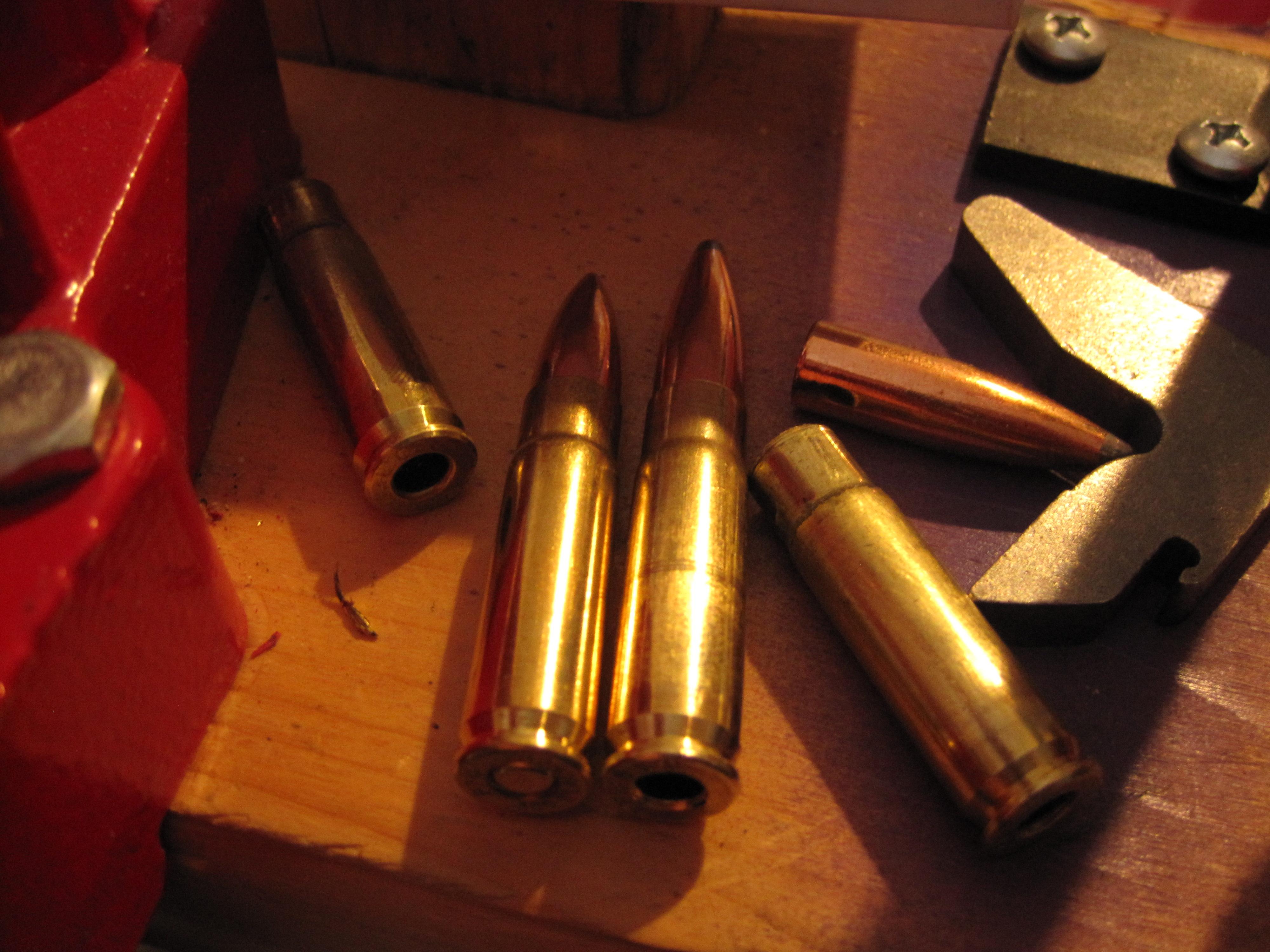
Thanks; and also for the refresher on the 300 Blackout process. I had read that before when you mentioned it a while back, and it was good to go over it again. I made up a few test cases and a dummy to measure. The spec on the neck diameter is .334", and this measured .333". I think that's pretty good considering the factory round I have is only .325". I don't think I'm going to need to worry about customizing my chamber on the barrel fabrications. I should be able to regulate with brass thickness and neck turning as needed. For some reason though; the bullet seating die I have will not stop anywhere near max length. I'm not sure how I'm going to resolve that (it wants to make much shorter overall length if the adjustment is at max). The only way I got even close was not moving the ram all the way up. Of course this too may not matter in the end; but it was surprising to me. I have not even tried the Lake City brass yet; this was all junk .223 I had laying around. Honestly I used a tubing cutter to trim these cases; while I wouldn't recommend it to anyone, it worked fine for these few after a bit of practice. Sure do need a lot of lube with the initial neck forming.
-
Lane's: jtallen83 inspired 21.750" 300 AAC Blackouts
Lane replied to Lane's topic in 300 AAC Blackout
I played with a ballistics calculator in regards to the lighter projectiles I could find for sale. I'm not exactly sure what to aim for without any actual data in hand; other than favorable BC. I can only estimate the muzzle velocity based on some other off weight information at the moment. Picked up a bag of 100 immaculate once fired Lake City brass a few weeks back on a whim. I had planned to reload those in .223; but I might as well convert them to 300 Blackout at this point. I will do a few in garbage brass first to get the rhythm. I know some people insist on case annealing; but that might not happen right away. I think a tight neck in chamber might help to protect against cracks. I don't remember seeing anything about annealing in the Houston Warehouse article; I'll check again before I make my decision on that matter. I know I still need a micrometer, and a tube micrometer of reasonable accuracy. Also a case trimmer unless I can make the resize die do all the work for me... I kind of doubt it. Still all depends on what the chamber casts look like. -
Lane's: jtallen83 inspired 21.750" 300 AAC Blackouts
Lane replied to Lane's topic in 300 AAC Blackout
I didn't even think about this because I don't have a pistol permit; but it looks like the SAFE act bans AR pistols in NY because of the weight. Only way to have one is to be LE, or have a strangely fixed magazine (bullet button isn't legal). The only one of those I'm aware of has special rivets into the magazine that destroy the lower if removed. I'm also not aware of any FFLs around here that are willing to play in that territory. Rifles are legal in NY... I'll see if I can clarify the SBR issue with my local dealer next time I stop in; I don't have any actual experience with it. I read some more about suspersonic projectiles, but I still don't have a clear understanding why they would be more accurate. I can clearly see why I want to stay away from projectiles crossing back into subsonic territory though. Plenty more to explore in that department. The wikipedia article on 300 AAC Blackout lists velocities in 24" barrels for a 78 and 90 grain projectile that I don't have load data for. One of them is listed as CQ, so they may not be very aerodynamic. -
Lane's: jtallen83 inspired 21.750" 300 AAC Blackouts
Lane replied to Lane's topic in 300 AAC Blackout
This is all true; and so far as I know, entirely legal get a tax stamp for an SBR in NY. That is where the NY State law picks up though; anything below 16" barrel length must be put on your pistol permit, and thus treated exactly like a pistol. NY doesn't issue open to carry permits to anyone without serious high ranking connections. LE, judges, very wealth people, etc. Even then; those people are instructed to concealed carry for the most part, because civilians are so nosey they will call the police any time they see one. I have never seen a pistol displayed in NY without a badge next to it on the belt. So far as I know, there is no law forbidding the open carry of a rifle NY; yet I've never seen that either. All you free Americans are welcome to play with short ARs from 1" to 15.9"; here in NY it's less hassle for me to stick with the rifle length, between 16"-24" in this case. 98Z5V says "stick with supersonics for accuracy in this build", I'm inclined to believe his advice on the matter. The 24" barrel I ordered is intended to be chopped down bit my bit. It may end up short enough to play with subsonics at some point; but of course suppressors are entirely illegal here. I'm quite fond of the heavy barrel on an AR; I think it looks slick and feels great in my hand. My 7.62x39 build has one in 0.900" diameter; and the accuracy thoroughly impressed me. These 300 Blackout builds will be experiments in terms of accuracy tuning. I expect the education I get in the process will carry over well into my past and future AR builds. -
Lane's: jtallen83 inspired 21.750" 300 AAC Blackouts
Lane replied to Lane's topic in 300 AAC Blackout
I'll try to keep this succinct... I live in NY; so far as I know, anything below 16" is considered a pistol by state law. That leads me to ask; why doesn't someone create a thread entitled: "Show me your attempts to concealed carry a 300blk pistol". I thought this was true as well; and was building a 300 Blackout rifle anyway. It was the lack of options for long barrels that made me choose this route explicitly. As as far as the 21.75" length in particular; I found the Houston Warehouse testing to be a very interesting and thought provoking venture. Much of the information provided goes a long way in describing accuracy tuning of some great shooters. I suspect, if the results as published were to undergo the scrutiny of peer review; that bit about 21.75" barrel resonance would have been called into question immediately. But; if the best guns in .22 and 30 caliber that shot there had barrels of exactly that length, it is in my mind a worthwhile reference point in testing 300 AAC Blackout with barrels 24" and under. -
Lane's: jtallen83 inspired 21.750" 300 AAC Blackouts
Lane replied to Lane's topic in 300 AAC Blackout
As I mentioned earlier; that's what made this challenge so attractive. There is a huge range of variables in this particular 30 caliber cartridge. I've not seen anything like it in my previous reloading experience. And now I have to build a castle out of this particular build set... I need the experience; and I personally learn/understand best through testing. Book work can make me gloss over the important facts in terms of math very easily. I simply want to build and test ad nauseum. I understand that the .308 Win cartridge might be superior in that matter. That's why I want a .260. You sold me a long time a long time ago @98Z5V ; but I didn't fully understand why until very recently. I've been considering various methods of barrel bedding; but I'm not 100% sold on its use, or necessity in the AR platform. I would be easily swayed by some experiential testing though. There may need to be a side by side 24" test if this becomes and issue. That is one of the reasons why I specified no less than four barrels for this experiment. -
Lane's: jtallen83 inspired 21.750" 300 AAC Blackouts
Lane replied to Lane's topic in 300 AAC Blackout
I stumbled across the chuck hawks on sd last night, but didn't finish reading up on bc. These often get lumped together, or set as constants in simple projectile math. I did pick up a usable chronograph to inspect what I have here right now in more depth. It actually looks easy to modify (very easy); so I can drill down to the highest accuracy the software supports pretty quickly. Unfortunately it may not work well in the extreme cold; so that remains to be tested. It was dusk by the time I got to shoot today; so I wasn't able to try it. That's something that made me think after your earlier comments... If you were nailing 200 with a 16" barrel; a long barrel on a 300 blackout shouldn't be a terrible idea. I've yet to try and project what to expect in terms of FPS from a 108 grain in a 24" barrel; but it seems like it should be fast. -
Lane's: jtallen83 inspired 21.750" 300 AAC Blackouts
Lane replied to Lane's topic in 300 AAC Blackout
I ordered the two initial barrels for this project and had them drop shipped to a fabricator for chambering, etc. A slightly longer lead time than I anticipated; but still shorter than most anywhere else I checked. Four to six weeks (or less), is what I was quoted. I'll probably be dormant for a while in this thread as a result. I have a lot of things to consider in the mean time; and I'm a bit nervous about chamber casting. Casting can be fun; but pouring into a small opening with a low melting point alloy will be interesting to say the least. I doubt my first attempt will be perfect. @98Z5V I was thinking more about our earlier discussion in regards to .260 Rem neck turning. In this case; the necks were turned down only 0.0007" below the chamber size. I'm guessing you leave a bit more clearance with a .260 in a semi-automatic? I don't even have tools to measure quite that accurately yet; but I can imagine that being an important factor in terms of accuracy. I remember seeing hints elsewhere that resizing dies should be lapped to get wider necks (for better fit)... In other news I got a reply from Armalite today. Apparently the AR-10 A uppers will be back in stock later this month; that will allow me to kick of my mostly Armalite .260 build. -
Lane's: jtallen83 inspired 21.750" 300 AAC Blackouts
Lane replied to Lane's topic in 300 AAC Blackout
Piss away man. In this case; I have some more reading to do... In short; heavier bullets just can't perform as well as the lightest in the same caliber because of the larger SD? More obviously; smaller calibers have a lower SD (or heavier projectile weight for same SD). So when ladder loading for accuracy testing; I will likely land on the high end in terms of powder charge? -
Lane's: jtallen83 inspired 21.750" 300 AAC Blackouts
Lane replied to Lane's topic in 300 AAC Blackout
So; given your earlier stated logic, I should be loading my 7.62x39 with 108 grains for speed and accuracy? Save the 150s for doing damage? This is part of what made it easy to decide say yes to more than one of these builds; and the experiments to go along with it. That; and the fact that I was unable to buy a 22" barrel off the shelf. -
Lane's: jtallen83 inspired 21.750" 300 AAC Blackouts
Lane replied to Lane's topic in 300 AAC Blackout
This is the kind of advice that will save me money down the road. I was shocked when my reloading dies showed up and I saw the range of projectile weights for this cartridge. I initially took an interest in this as a stepping stone towards making .260 Rem from .308 Win brass. -
Lane's: jtallen83 inspired 21.750" 300 AAC Blackouts
Lane replied to Lane's topic in 300 AAC Blackout
I will look into this a bit further; the twist on these will be 1:7. The loading data I have here on paper shows even 150s and 168s can launch supersonic. I'll run the numbers to see what's still hitting targets above the speed of sound. I knew I needed to test a range of projectile weights; so I'll start my reloads small and fast. The box of factory 300 blackout I have on hand are 125 grain; so I'll see how those land right out of the gate. I appreciate all the input on this. -
Lane's: jtallen83 inspired 21.750" 300 AAC Blackouts
Lane replied to Lane's topic in 300 AAC Blackout
It is unfortunate that Virgil doesn't specify what the 30 caliber was that shot so well, only that it was his own gun. His 22PPC was apparently the best; just a necked down 7.62x39 from what I can see. The fact the both of those were his guns leads me to believe his case prep may be a huge part of that accuracy. I didn't want to yell this out in the other forum; but I don't actually believe any part of this 21.750" barrel length business. But I'm game to put my money where my mouth is, have fun with it; and see what the data says. I won't be upset regardless of what I learn in this process. -
Lane's: jtallen83 inspired 21.750" 300 AAC Blackouts
Lane replied to Lane's topic in 300 AAC Blackout
I'm in agreement here from a scientific perspective. It was the barrel length that started this whole discussion though; and was clearly stated as some kind sweet spot in the article. It was further supported by saying "the best 30 caliber, and best 22 both had 21.75" barrels". That's what the 24" barrel is intended for in this first order. The 21.75" is of course a reference to test that against during the process. I haven't fully crafted a hypothesis on this, but I don't think these first two are a waste of money. I'll absolutely listen to any comments, and read more about this. I'm well aware that I'll need to take chamber castings, and spend a lot of time developing my reloading to make this a realistic investigation. Once I feel like I've learned something from cutting up that 24"; I will consider future barrel options. Clearly my sense of humor about this matter doesn't always come through this medium. I had a 300 blackout build in need of a barrel. This is at the very least motivation to finish that/them, and start recording data about the accuracy of my builds. I have no illusions that my small sample size can't really add scientific value; but it is still worthy of rigorous inspection. I will always strive to be a better shooter, and build more accurate firearms. I am curious to see if these thicker barrels flex in any appreciable way when fired. -
Lane's: jtallen83 inspired 21.750" 300 AAC Blackouts
Lane replied to Lane's topic in 300 AAC Blackout
About to get the first two barrels moving for this project. One question I have is whether it's worth getting the local gun shop involved in the process? In the past I've done most of my business without their aid; but it seems like they typically get decent pricing as a dealer, and I pay about the same letting them get a cut of the action. I would be interested to know if anyone thinks it is worth the time to involve a third party. So the Shilen #7 contour doesn't appear to be a contour at all. It's roughly what Green Mountain sells as their gunsmith edition barrels, which is what I wanted to to test against in the first place. The 7.62x39 barrel measures 0.900", and this specified #7 is 0.890"; I will happily settle for 0.890" on all the barrels. Going to start is with two custom barrels, at 21.750", and 24". Still on the fence about sending bolts for headspacing or not. Will I end up with better consistency if they just make two barrels to specification, and I'll have to check bolts for fitment and headspace? The reason I consider this is trying to introducing as few variables as possible. I found an indoor 100 yard range less than two hours away. Unfortunately, I presume they have some kind of ventilation system; so it won't be perfectly still air. It is still worthwhile in my mind to add additional data points. -
Lane's: jtallen83 inspired 21.750" 300 AAC Blackouts
Lane replied to Lane's topic in 300 AAC Blackout
I'm just going to throw down one more card here. I will commit to four build/barrel minimum on this. The specification is #7 contour; so the first 21.750" is going to be just that. I also want a 24" in #7, a 21.750" in .900-.936", and a 21.5" in .900-.936". Not sure how long to plan on the three fabrications; but one of those shoots in March; well before the snow is gone.