
W.E.G.
-
Posts
122 -
Joined
-
Last visited
Content Type
Profiles
Forums
Downloads
Gallery
Store
Everything posted by W.E.G.
-
This is what the "reaction rod" devise looks like when it is married-up with a 1/2"-drive breaker bar. When engaged into the lugs on the barrel extesnsion, this gives the leverage that allows you to tweak the timing of the barrel in the upper receiver just a smidgen. Close-up of lugs on reaction rod that engage the barrel extension lugs when doing this process.
-
For the benefit of readers who may be less-experienced with the tools involved, here is a pic of the Wheeler Engineering tool grabbing the upper receiver by the Picatinny rail. The Wheeler tool gets clamped in a vise. Here, I'm using aluminum jaw-covers to keep the vise from marring the tool. The tool is basically a slotted piece of aluminum that slides over the Picatinny rail, and which is compressed by the vise to provide a very firm grip of the upper receiver while you wrench on it.
-
Sorry, I forgot to hit "publish" on the youtube site before copying the youtube link in the previous post.
-
On the suggestion that the timing of the barrel-extension and bolt could be out of whack, I removed the barrel nut again. The slot in the upper receiver for the index-pin on the barrel-extension is quite narrow, and allows almost no lateral movement. See the video below. I used a Brownells reaction rod in conjunction with the Wheeler Engineering upper receiver action block to make a very small timing-adjustment. Click link below to view one-minute video https://youtu.be/iUXljAs2tiQ
-
Tell us about the extractor. Does it have two counter-wound springs? Do the feed ramps show any signs of grinding?
-
As I sit here pondering this, I'm beginning to feel fairly certain that this is the situation: The bolt and the barrel-extension are not "timed" correctly relative to one another. As the bolt moves into battery, the leading edge of each bolt-lug impacts the clockwise-face of each barrel-extension lug. This impact batters the leading edge of each bolt lug, causing the each bolt lug to carve a channel into each of the corresponding barrel-exteinsion lugs. As an "impact-channels" are created, metal on each barrel-extension lug is displaced to form a burr on the chamber-side of each barrel-extension lug. The burr on the chamber-side of the barrel-extension lug then chisels the trailing edge of each bolt lug as the bolt unlocks during cycling. I wonder whether this violent mis-timed relationship between bolt and the barrel-extension will "wear-in" to a point where the damage caused by each cycle of the bolt will be less? This raises several other possibilities: Is the mis-timing due to the timing-pin-slot in the upper receiver being cut out-of-time, or is the mis-timing due to the pin in the barrel extension being located out-of-time? Is the mis-timed relationship a product of "stacking of tolerances" where both the timing-pin and the slot in the upper receiver might be each out-of-time (in opposite directions)? Could there be a third timing-factor?: Is the channel in the top of the upper receiver mis-timed (this is the channel which guides the key on the bolt carrier as the carrier reciprocates)? Or perhaps a fourth timing factor?: Is the central "tube" axis of the main channel in the upper receiver not true relative to the "tube" axis of the barrel extension?
-
Getting back to the issue of the lugs on the barrel-extension, I highlighted the pic to show wear-marks on the lugs. I'm not sure what is the best terminology to use to describe the locations of the wear-marks. I guess I'd say the deepest marks are on the "clockwise" faces of the barrel-extension lugs. However, if you look closely less-prominent wear-marks exist also on the opposite-side faces of the barrel-extension lugs. Somebody brought up the issue of whether the barrel extension may not be ideally "timed" relative to the timing of the bolt. I guess this is some evidence that the bolt is not perfectly timed, to wit: the bolt appears to be timed slightly counterclockwise relative to the lugs on the barrel extension. Therefore, the clockwise faces of the barrel-extension lugs are giving the bolt a beating as the bolt negotiates the barrel extension. It was also asked whether there appeared to be any slop in the slot on the upper receiver. The idea being that such slop would allow the barrel to shift clockwise/counter-clockwise, and that could cause the bolt to have to beat its way around the lugs on the barrel-extension in an inconsistent manner. I did remove the barrel from the upper receiver for inspection. I was impressed with the tight tolerances - especially the tightness of the barrel extension in the cylindrical part of the upper receiver. During that disassembly/inspection/re-assembly I wasn't specifically looking for slop in the slot/barrel-pin engagement. But, I'm confident that I would have noticed significant slop in that dimension if it had been present.
-
A question was asked about the firing pin. The tip of the firing pin measures 0.080" and it appears undamaged. I'm not having any issues with pierced/blanked primers or "volcano" primers swelling back into the opening in the bolt. So far, I've fired Santa Barbara surplus ball ammo, and a couple handloads (41.5 IMR4895 with 168SMK and 40.5 IMR4895 with 173-grain "M118" bullet).
-
Some PA-10 owners have complained of the bolt carrier slamming into the rear of the receiver, and cutting gouges in the threads for the buffer-tube (receiver extension). Mine does it a little bit. But really only a very little bit. I think mine did this on the first outing, and the condition has not worsened at all since then.
-
It was mentioned that the SCAR series of rifles require that the Magpul PMAG be modified (widen slot in back of mag) in order to keep the magazine body from causing the bolt-hold-open device to ride up when the magazine is inserted. This does not seem to be the case with the PA-10. Here, with the guts out of the mag, I can insert the mag-body and wiggle it around without causing any movement of the bolt-hold-open device.
-
Three pics of the locking lugs on the barrel extension:
-
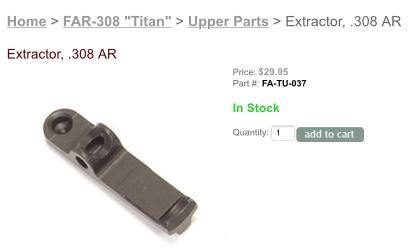
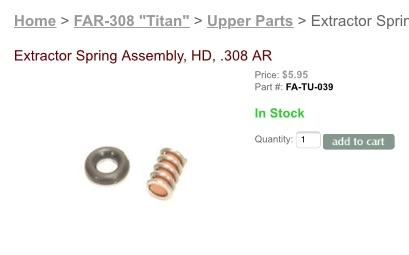
All the feed problems were cured 100% after replacement of the Palmetto extractor with the Fulton extractor.
-
I haven't kept close-count on the number of rounds fired. Here is what the Palmetto bolt looks like after around 300-400 rounds. Probably closer to 300. Lots of peening of the bolt lugs. Raising enough burrs on lugs to snag cotton-fibers from Q-Tips.
-
It bears comparison that the AR-15 type firing pin has a much more rounded/tapered head. I’ve wondered why the Palmetto and DPMS pin-heads have such a flat-angle head-shape.
-
While cleaning the PA-10 today, I noticed that the head of the firing pin is beginning to "mushroom." This pic shows the condition of the firing pin after approximately 300 rounds. No evidence of deformation at the tip of the pin (the part that strikes the primer). I am running a Geissele "National Match" trigger group with this firing pin. Since taking this pic, I have used a file to remove the deformed metal from the head of the firing pin.
-
Another range trip today. Heat index 101* Sorry for the blurry pics. Didn't have my glasses on when I took the pics of the targets. Couldn't tell that the camera wasn't focusing. The wandering-elevation issue appears to be resolved. I was pretty gassed by the time I tried to shoot the sitting position. I was playing around with some different ammo and also turning scope-turret knobs. Doesn't explain the scattershot. No, the scattershot was me trying to shoot a .30 caliber service rifle rapid-fire from sitting position when I was gassed from the heat. Of course, the camera decided to focus when I was looking my worst. Keeping it real.
-
I plan to shoot the rifle in an 800 point match next weekend if I don’t get stuck calling the firing line. If I get stuck with that job, I may stay late and shoot a simulated match if the heat index is bearable.
-
I replaced the extractor and spring assembly in the Palmetto bolt. Some folks reported significant issues with primer-extrusion with the Palmetto bolt. I have not experienced this with my handloads or Spanish “Santa Barbara” surplus 7.62. These are the Fulton Armory parts I installed in the Palmetto bolt:
-
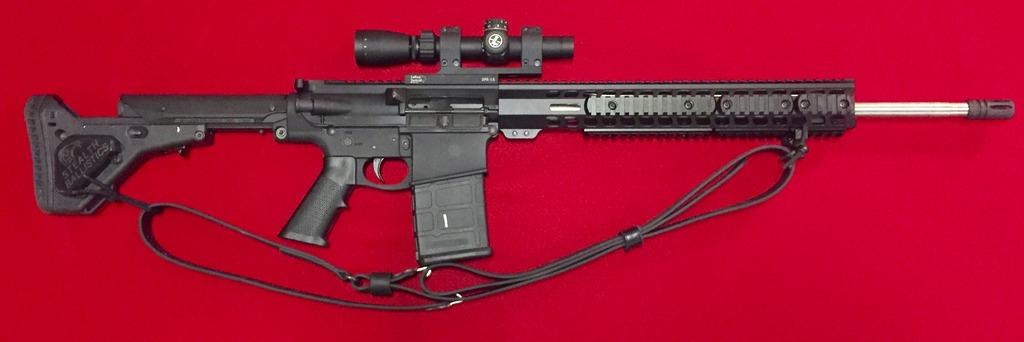
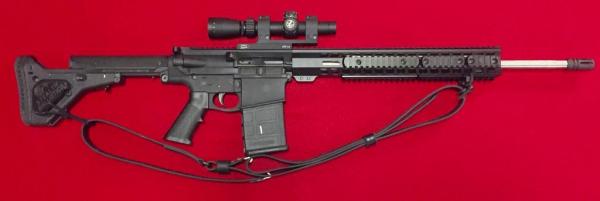
Pic taken before installing the Magpul XTM cheese-grater covers
-
Almost forgot to mention, Larue LT-104 scope mount and Leupold Mark AR green firedot 1-4X scope!
-
So, here's what it took: replaced short Palmetto gas tube with rifle-length AR10 gas tube replaced non-functional Palmetto extractor with Fulton Armory AR10 extractor and extractor-spring replaced basic trigger with Geissele National Match trigger replaced basic collapsible buttstock with Magpul UBR generation-1 buttstock installed Magpul 0.70" thick enhanced buttpad replaced basic carbine buffer with KAK 5.3 ounce carbine buffer replaced Palmetto carbine buffer spring with DPMS LR-308 buffer spring (not sure there's any real difference between the two) experimented with adjustable gas block, but ended up just using the Palmetto gas block (its decent IMO) polished ham-handed grinder-marks off feed-ramps on barrel extension added as many keymod cheese-grater bits as the handguard would accept (main purpose was to increase weight) added Magpul XTM forearm panels to rearmost cheese-grater bits to keep cheese-grater from eating my left hand during sling-supported firing mounted pushbutton 1.25" sling swivel to forward cheese-grater bit at 6 o'clock to comply with NRA rule for service rifle swivel location mounted Turner all-weather service-rifle sling added Stealth Ballistics buttstock weight to UBR stock (improve balance and increase weight) obtained wrench for removal of barrel nut from Harbor Freight (12" adjustable wrench) - modified wrench by thinning wrench-jaws and wrench-frame with angle-grinder and chainsaw file. removed barrel for inspection, then reinstalled re-torqued the barrel nut with a couple extra ugga-duggas (technical term) Now I just need to go shoot a 500 in the National Trophy Individual Match. LOL!
-
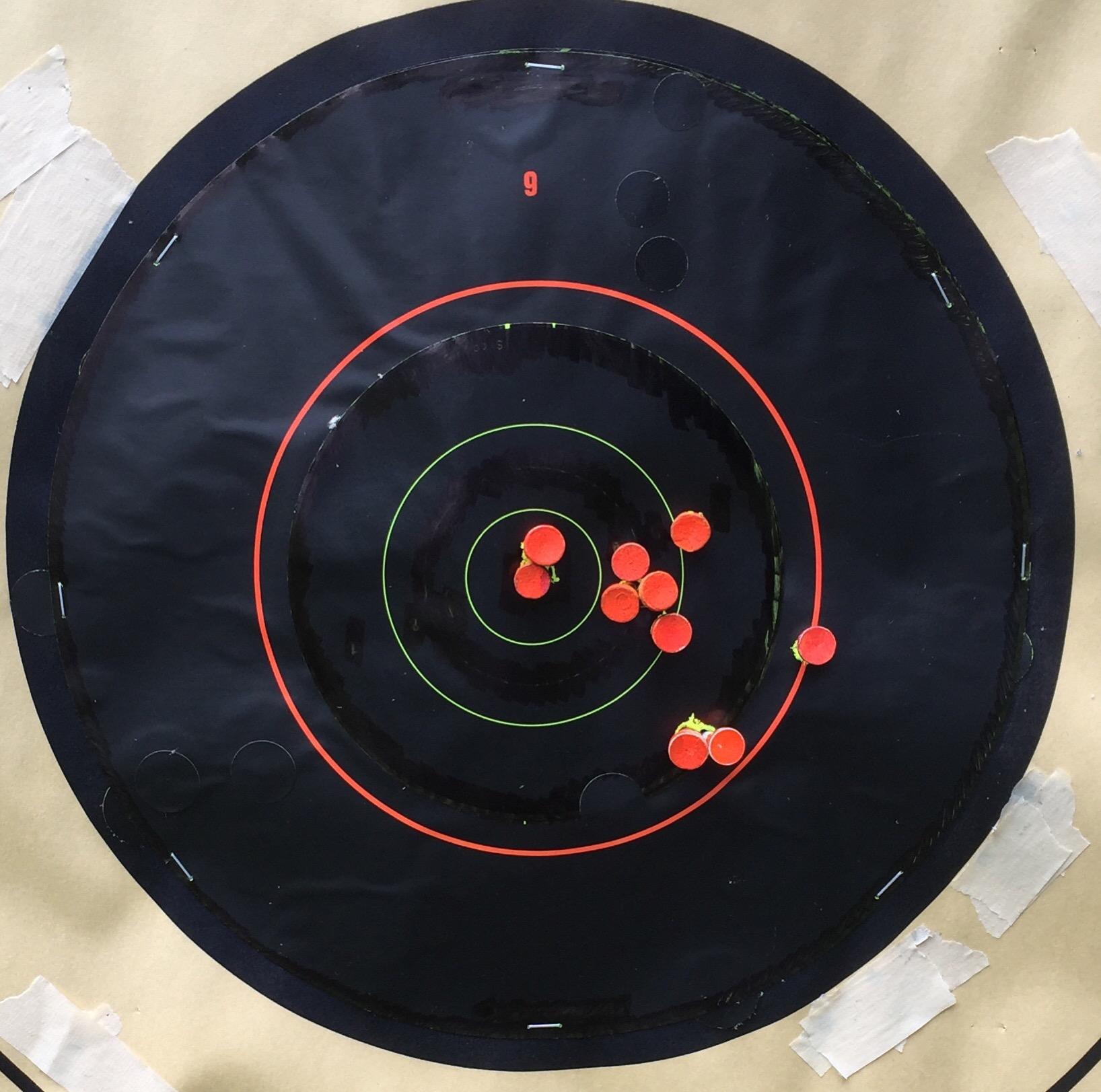
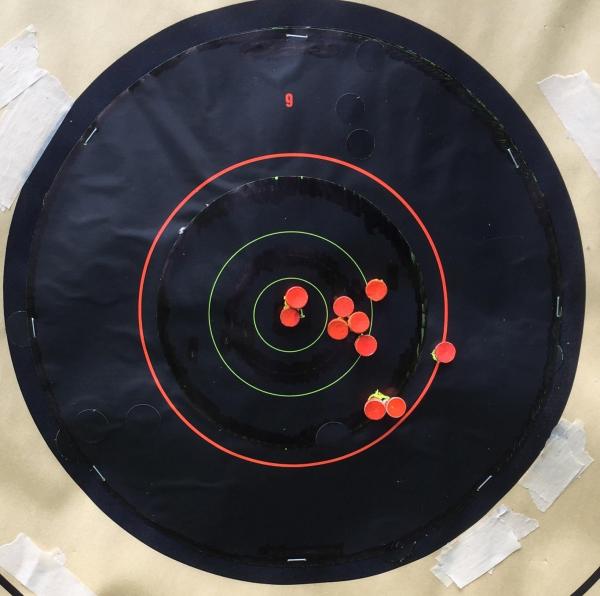
This is acceptable. 200 yards. Prone. Sling supported. Fired from magazine. 41.5 IMR4895 - 168 SMK
-
I removed the Palmetto barrel from the receiver yesterday. The barrel nut seemed appropriately-tight as I removed it. I had to piggyback a big-ass trailer-hitch box-end wench over the handle of a 12” adjustable wrench to break the nut loose. No threadlocker was present on the barrel nut. Some sort of white-colored grease was evident on the threads. Once the nut was removed it took some legitimate wrestling to get the barrel to pull free of the receiver. That’s a good thing. I couldn’t see any flaws on the mating surfaces of the barrel extension or the receiver. I cleaned up the shoddy grinder-marks on the feed ramps before re-installing the barrel. After applying some fresh synthetic grease on the threads, I used the same piggyback wrench trick to tighten the barrel nut. I snugged-loosened the nut three times before sending it to full torque. Range trip today to see whether it’s still shooting vertically-strung groups.
-
Just in case nobody noticed, this thread is over a year old. OP last posted over a year ago, and never gave any report of what ultimately happened with his rifle.
-
I shot a simulated 800-point match today with the PA-10. All firing done at 200 yards (used reduced targets for rapid-fire prone and slow-fire prone). I fired on the targets in the reverse-order of how they are typically fired in an NRA/CMP match (i.e. shot prone first). I had no reliable zero for sitting position or offhand position, so figured it made sense work-into a zero that would put me into the ballpark. I’m pretty happy with the result. You can see that I’m still having significant issues with maintaining a good elevation hold. I have this problem (holding consistent elevation) some when shooting the 5.56 AR. Clearly, I’ve got my work cut out for me to get a handle on it with the 7.62. To give you an idea where I am in terms of ability to hold, I reliably shoot “master” scores (94%+) from prone and sitting position. Typically expert scores (89% - 93%) offhand. A few remarks about the targets: 600-yard target reduced for 200 yards. Single-feed loading. Breaking position to reload on each shot. When I began, I thought I already had a solid zero for the load (168 SMK / 41.5 gr. IMR-4895). First shot was that scratch-ten at ten o’clock. Figured good-to-go. Next several shots were SUBSTANTIALLY LOW. Several 7’s. That was pretty annoying, so I started cranking elevation onto the scope until I found my way back into the middle. Little-by-little, I ended up adding a total of TWO MINUTES UP elevation. At about the fifteenth shot, I was out the top. So cranked about a minute down. I think my elevation issue is a function of trigger-control and follow-through combined. I just need to keep working on it with this gun, or I’m going to continue to have slow-prone targets that look like this. 300-yard reduced for 200 yards. Using same load as previous target. You will notice this target also has vertical stringing. Perhaps slightly less-pronounced than the “600-yard” target. This target was fired with the same sight-settings as were used to fire the final shot on the “600-yard” target. Most shots are a bit right too. The displacement to the right is a function of getting on the trigger harder to maintain “rapid-fire” pace. Causes the shots to be pulled a little right for right-handed shooter. 200-yard sitting rapid-fire target. Using surplus Spanish “Santa Barbara” ammo. I fired five sighters on a target not pictured in this post. Using the same sight-setting as the previous target, and much to my surprise, the five sighters landed neatly in the 10-ring and at the ten o’clock position where I like my sighters to go for rapid-fire sitting-position. My sitting-position sighters always mislead and lie to me. The first string of ten shots was enough high and right, that I felt a sight adjustment was warranted. Not wanting to really screw the pooch, I made a too-conservative adjustment of only one click (one-third minute) down, and one click left. From the looks of the target, I could have used a more significant down and left adjustment. Still a master score for the first time firing this rifle from sitting position. So, I guess I’m not too disappointed. Offhand target. 20 shots standing. Zero was a little weird on this one. Started with the same sight-setting as used on previous target. Over the course of the 20 shots, I ended up coming DOWN TWO MINUTES, and also RIGHT TWO MINUTES. So, blew a lot of 8’s high early. Those 7’s on the left, I’ll just own them. Would have probably been 8’s if I’d had the best dope on the gun, but still out there because I shot them out there. Well, there it is. That’s what this rifle “could do” in a match. Really more like what I can do with this rifle in a match. As I mentioned before, I’m no great offhand shooter. I’m pretty dangerous once I get off my feet. I am confident that most of the points lost from supported positions were a function of not having a really good zero for those positions, and also imperfect shot execution. I don’t think this upper is a “lights out” specimen. But, its really not bad. The shooter needs the most work by far.