

98Z5V
-
Posts
39,690 -
Joined
-
Last visited
Content Type
Profiles
Forums
Downloads
Gallery
Store
Everything posted by 98Z5V
-
Chainsaw got hosed by his vendor.
-
Completely, between AR15s and .308ARs. 100% the exact same part, with zero differences between them, across those two platforms. Zero differences.
-
I'd love to hear the back-story on this SR-71 deal, right here...
-
Reason I asked - you got fucked. Here's what the MagPul QD End Plate looks like: What you're showing certainly doesn't look like that... I'm just sayin'...
-
Where did you buy this part from?
-
Sad. Well, not really. Excellent work, homeowner. You did it well.
-
This is what we run in to here. Hate to say it, but you get what you pay for. I'm not "snobbing" anything, I ain't about that. However, you build a gun with quality parts, and it runs. Pick the parts yourself, and do it wisely You buy a budget gun, and you better be prepared to work on it to get it to do what you thought that Knight's SR25 was gonna do (Yes, I know the difference between the Remington R25 that you referenced, and the KAC SR25, and I'm using the SR25 as the dollar/quality reference on my own) . That PSA dollar comes from somewhere, and you got it cheap for a reason. Compromise was made somewhere. At least you are here, right now, painterman, figuring out your gun. For the most part, the budget price of the PSA attracts the "budget people" that think everything had a lifetime warranty, and it should run out of the box just like an SR25 - and that's just not the case. I hate - HATE - arguing with those "budget people" over this shiit. PSA doesn't care, either - they already made their money...
-
Not new, you can't. It's up there.
-
At 37:23 in that video I linked above, Brian Shul talks about his book he made. Sled Driver. If you ever find this book, prepare to pay. Last I looked, it was over $700... !!!... !!!...
-
Crazy how big they look in pictures - and how small they are in reality... It's amazing that the front of that thing is just over 6 feet off the ground. It looks, in pics, like it would be 20 feet off the ground... Unreal aircraft. Part of my fascination with them is my work with the predecessor, the U2. I worked with those things in the early 90s, when they were still flying.
-
This plane - and this specific pilot, MAJ Shul - hobby of mine for a long time. Amazing. Here's a good one.
-
He's a historic legend. Here's an infamous story from him - this is him speaking...
-
^^^ I'd neither heard of that, nor seen that before. Wow.
-
I knew there was zero disrespect in your comment... and I'm just an ass... You either love me - or you can't get away from me, once I crawl up your ass and spread out like a Spider Monkey...
-
This reminds me of a military quote, Occifer versus Enlisted. The Officers were "managers" but the Enlisted ran the show, daily, every single day. I was Enlisted. "Sir" is what you called the Officers (Occifers). I worked for a living, and wasn't a "manager," like the higher-paid Officers. You'll hear that often, in military circles, when you call someone "Sir..." The response usually is "FUK THAT! I'm not a "SIR" - I WORKED for a living!"... Officers suck. Only the successful Officers had some STRONG Enlisted men shaping their careers. The unsuccessful Officers were micro-managers that didn't listen to their Enlisted Senior NCOs, or just had weakass NCOs under them - and those NCOs didn't uphold a standard. Weak NCOs SUCK, and they only breed fucked up Officers. Strong NCOs fuk young Lieutenants up with regularity, early in their Officer career, and guide them on the path of true Military Leadership. "Give them enough rope to make mistakes, but NEVER give them enough rope to hurt someone..." Let 'em fuk up, but REIGN THAT ASS IN BEFORE IT GETS SERIOUS. When that is about to happen, you must seriously LAY THE SMACKETH DOWN UPON THEM. I never wavered from that. I've issued some incredible ass-beatdowns upon them, sometimes in private, afterwards - and sometimes it's not gonna wait for that... And you do it NOW - in front of everyone. "You never chastize a Superior in front of Subordinates" has it's place, in normal circumstances - but not always. Sometimes you need to blow the fuk up, no matter who is around... Real lessons get learned, right then... So, I'm not a "Sir," I worked for a living... I am simply "Tom-Ass..."
-
Awesome hunting ammo, from a bolt gun. Anything with a leaded soft tip is a hazard in a semi-auto with feedramps and bolt lugs like an AR. Switch ammo and try something different.
-
We're here for you - make no mistake about that. Fret it not, brother.
-
I've done my trek up giant-ass Nisqually 110-foot pines, to recover parachutes. About 1/2 a dozen times. Fuk that. You run a Drop Zone and have an idiot that can't steer a steerable parachute - land in a tree off the drop zone... You call a helicopter to extract his dumb ass from the tree - and the parachute stays there, WAY up in the tree. As the guy running the Drop Zone (DZSO), YOU are signed for all the gear, including that parachute, that is WAY UP THERE, in that tree. Turns into a "Statement of Charges" in the long run. Hell no, not on MY watch. I go back out there and get that parachute outta that fucking tree. Close drop zone, issue numerous reports (Jumper off DZ, eqmt left on DZ, etc). Safety reports out the ass - because some dummy can't fly. So, next day, hit up the Commo dudes and sign out their pole-climbing spikes, chainsaw, harness, and two sets of straps - set one small, and the other one big. Go back out to the DZ, easy to find that parachute blowing in the wind, 100+ feet up there in that bigass tree... Strap on the spikes, size up that large strap to fit around that bigass trunk, tie off your chainsaw on a 6ft tether to the belt - and start climbing. You "Q-Tip" that tree - cut off anything on your way, on the way up. Once you hit the point where the big strap is too loose - you setup and transition to the short strap - and keep going until you get to the parachute. You'll get that fucker out of that tree, one way or the other. I'm not paying for a parachute... I only had one try to take me out - I got the parachute free, and that fucker was crashing down quick-like - and wrapped around me, tied to that tree. It turned me upside down, and the only thing keeping me from skidding down that barked-up bitch and dying- was sling tension. That short strap locked up against the tree and kept me up there. I cut the FUK out of that parachute to get it off me, upside down, 100 feet up. Didn't really matter how many pieces I brought it back in - as long as I brought it back. I went up after one of them that had to be 130 feet up there - and said "Hell no..." I came back down, and cut the tree down. When it was coming down, the parachute got stuck in ANOTHER tree on the way down, and stopped that shenanigan from happening. I cut the OTHER tree down. Never once did I ever leave a parachute out there - no matter HOW DUMB the jumper was... I will NOT disclose the location of claimed shananigans, because cutting down trees was strictly verboten. Q-Tipping them was never mentioned in ANY Range Regulations, and I never had ANY problem doing that business. That one fucker, though... I wasn't leaving it out there, no way, no how...
-
Pics of what you have (rifle config), and what you bought -will be invaluable here...
-
Wilson Combat produces them, and they make great, accurate barrels. https://shopwilsoncombat.com/6mm-Creedmoor/products/1007/ However, use Armalite AR-10 gas tubes, and be ready to drill up the gas port diameter, possibly. My .338 Federal was dead-on the money, in gas port size. I might be drilling up my .260 Rem barrel. Both needed Armalite AR-10 gas tubes. Other examples of WC barrels here needed the same, for gas tubes, every single time - some of those other calibers might need gas port work. We'll see how they shake out, over time.
-
I could get further into this - in using AR15 gas tubes in a .308 AR, and the bend being incorrect, but it's a pain in the ass. Basically, the bend isn't correct, using an AR15 gas tube on a .308AR. I posted pics of this awhile ago. Anytime you're using an AR15 gas tube on a .308AR, you're making a compromise. It's a height-over-bore thing.
-
Completely depends on their behavior - he has enough of his own wild-asses to corral...
-
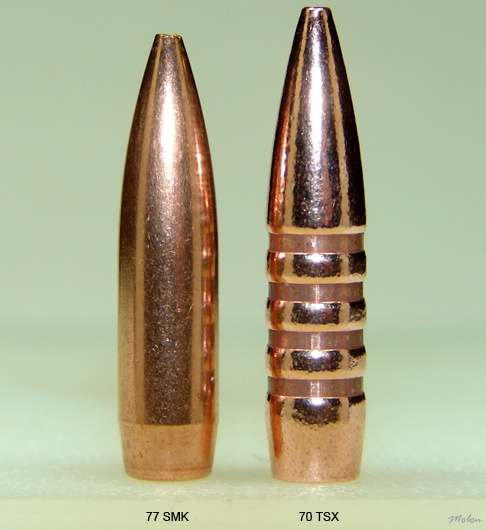
YOu cannot go wrong with Barnes bullets. Since they are all copper (some tipped, somenot), you have to be careful loading them. Copper is lighter than lead, so a lighter copper projectile can sometimes be longer than a combo lead.copper projo. Let me get into this a little here... When we usually talk about "heavy bullets" - what we're really talking about is longer bullets. You load a projectile, determine a twist, etc, based on weight, right? Usually, yeah, but in the case of composites or solids, the answer is NO. You really load a projo based on length of the projo. Where you usually see this is "heavier is longer." Since you're constrained to a bore diameter, you can't go bigger. To go "heavier" means you go longer on the projo - in most cases, with similar projo construction (lead, copper jacket, boat-tail, open-tipped, whatever combo of features). Heavier is longer. Not the case with solid copper. For example, I give you the 5.56 analogy - here's a 70-grain Barnes TSX in .224" diameter, compared to a Sierra MatchKing 77-grain "heavy.": You load that Barnes 70 TSX with the common load values that you would load a Sierra 77 SMK with. That 70-grain projo is longer than a 77-grain SMK... As far as expansion, the Barnes TSX and TTSX line expand in an equal manner as the SMK/TMK.GameKing line (excellent expansion), but they commonly retain MORE weight, when recovered. The solid coppers retain more weight. That in itself makes them a superior hunting projectile, and it's what makes them so successful/deadly on game. You load them right, and you've just made a superior hunting machine out of your gun. I load enough of them in various calibers, so I bought the Barnes Load Manual for reference, just for these projectiles.
-
That would be plenty. I'm not sure what the resolution is on mine, but I'll try to find out. EDIT - Couldn't find any data on resolution, except for one review for a Competition Electronics Pocket Pro II timer, which "measures near 1 ms..." Great info on specs in this article/review on it: https://www.usacarry.com/pocket-pro-2-shot-timer-review/
-
THE MACHINE!!!