
98Z5V
-
Posts
39,690 -
Joined
-
Last visited
Content Type
Profiles
Forums
Downloads
Gallery
Store
Everything posted by 98Z5V
-
What a riot to shoot - true on the ammo budget, too! Shot Mikedaddy's last week, and loved it. I think the last time I shot anything with a 3-position selector switch was in late 2003. This is as close as you're gonna get without spending more than $10k on a Pre-May '86 lower and a stamp. THAT'S where the Big Grin Factor comes in!!! <lmao> What a hoot!!! <thumbsup>
-
I know somebody's gotta have pics, that was there - post those things up! <laughs> That part was cracking me up... <lmao> Went back out to the Cowboy Shoot today, for the awards ceremony. Greg picked up a bunch of raffle tickets the other day, for the Dillon RL550B setup they were giving away. Didn't win it, but the awards ceremony was hilarious! <thumbsup> I picked up a Mernickle holster for the Kimber Tac Pro II, and got a great big hug from Sherrie Mernickle herself! AWESOME! :love4: I also dropped off the Desert Warrior to a custom grip maker. Having a set of Box Elder grips handmade, from a SWEET block of wood I picked out. It'll take about 6 weeks, but pics will be up immediately when I pick it up. Here's the holster I nabbed - only paid $60 for it, too. <thumbsup> http://www.mernickleholsters.com/ps/ps6r18.html
-
<laughs> <lmao>
-
No acceptance of my comment whatsoever that I fondled your rail for over a full day, without your supervision... <lmao> You must be damaged by my comment, in some fashion... <laughs> I ran my hands all OVER that thing, brother... :o ;D <munch>
-
^^^ What he said. That's the freefloat that was on his .308 carbon-barreled beauty, too. I fondled that once you dropped it off (Rob), and it was in my possession for more than a day... <lmao> Just sayin'... :o
-
Don't know, brother - I've been meaning to measure gas ports for a long time, and just never have. I'll be damned if I'm taking guns apart now, just to get those numbers, and I've forgotten to get them on the last few I've slapped together,... but I figure I better start now. <thumbsup>
-
My search didn't take long, and this is what I came up with: http://lmgtfy.com/?q=Pete+the+ar+wizard Might be something to check into. <thumbsup>
-
I have LOTS of secrets in my gun closet, brother. LOTS... <laughs> <lmao>
-
How many 5.56 cases can you stuff into a 1-gal Ziplock freezer bag? I have no idea. <dontknow> I have this many 5.56 cases to load - this is one year's worth of shooting, for me.
-
From a military standpoint, there are exceptions to some state's gun laws, and there aren't. If some states have certain AWB laws in place, and as a military member - you get an assignment to that state. "Oh poop, what am I gonna do with my firearms?..." You can get an exemption, or exception, to take them there - personal firearms, now - but you can't use them there. You're not "against the law" to take them there, but you are against the law to take them out and use them on a civilian range in that state. NY comes to mind. Another thing with .mil. If I'm a military guy in an AWB state, there are things I can't buy online and have shipped to my residence - that state precedence and law is still in effect. Mag capacity for AR-15s is one example. I can't hop onto Brownell's and order up a bunch of 30-rd Pmags and get them shipped to me. There's nothing that says, in example, if my unit is using Pmags, and I can't get a grip of them through work, though. <thumbsup> In AWB states, there are separate rules for MIL and LEO - usually, LEO has alot more flexibility. As they should, IMHO.
-
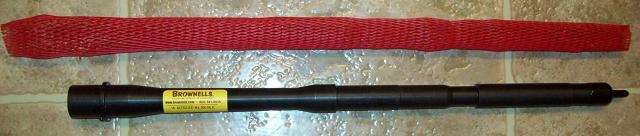
The barrel arrived a few days ago, but I've been too busy here to get pics and post them. I blame Greg - he's "time consuming..." <laughs> <lmao> I like the "Reservoir Tip" they use as a thread protector - nice touch. <thumbsup> This is one very nice barrel - gas port diameter is 0.098", for informational purposes.

-
Brother, you might honestly like it enough to see if you can get it from the shop. Seriously. ;D Use some decent 68~69gr match ammo through it, and you'll be very impressed. <thumbsup>
-

Im new here! Here is a pic of my build.
98Z5V replied to PapaDawg98's topic in DPMS LR-308 | Bushmaster 308 Pictures
The Surefire earpro is excellent. <thumbsup> -
LEOs also have a responsibility to the public, on and off duty. Off duty, some bullpoopy goes down and you're right there, then you respond. I think they deserve to have what is limited to a civilian. In alot of cases, they need it just like being on duty.
-
Only during holiday weekends, usually 10% off. Next one that I know for sure that is coming up will be Veteran's Day. They'll have a sale then. That one, and President's Day, usually 15% off. If you wait that long, the BCGs probably won't be there...
-
Take the taper pins out of the front sight base, then cut it off. Replace it with a two-piece gas block, and the freefloat handguard of your choice. <thumbsup>
-
Ergo makes the ladder covers: Google-search for the best prices - they're not very "mainstream," so they're not easy to find, unless you go to online sources.
-
Fulton Armory. In stock.
-
Damn! :o That's an awesome group of lead-slingers!
-
For the Pink: http://www.tacticalintent.com/AR-15-Kitty-Pink-Furniture-Fits/dp/B005BTMT72?class=quickView&field_availability=-1&field_browse=3249731011&field_product_site_launch_date_utc=-1y&id=AR-15+Kitty+Pink+Furniture+Fits&ie=UTF8&refinementHistory=brandtextbin%2Csubjectbin%2Ccolor_map%2Cprice%2Csize_name&searchNodeID=3249731011&searchPage=1&searchRank=salesrank&searchSize=12 Damn, that one longass link... :o I used the Midwest Industries Gen 2 two-piece freefloat rail on Pinky: http://www.midwestindustriesinc.com/index.cfm?fuseaction=category.display&category_ID=422 By the way, Rob looked really good shooting Pinky... <thumbsup>
-
All the LaRue Stealth uppers are 5.56, if I'm not mistaken. Stainless barrels, poly rifling, 1:8 twist, and .223 Wylde chambers - that combo makes for a badass-accurate piece. Sling some 68~69 BTHP match ammo through that, and the groups will make you smile. ;D If my old issued 14.5" M4 would crush targets at 600 yards, on the KD Range, then the 16" Stealth would do even better. I built a damn nice 16" midlength just for that purpose, and it is accurate - very accurate. Easier to carry, easier to maneuver, and I wouldn't need anything more inside of 600 yards, even on 2-legged predators. <thumbsup> See if you can try that thing out, micro.
-
Fantastic! <thumbsup>
-
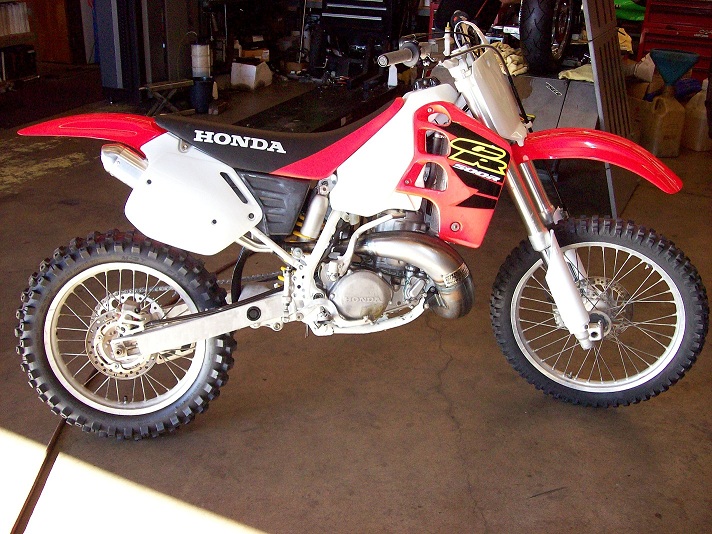
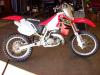
Finished this bad boy. Full rebuild on everything - forks, rear shock, engine (bored up one, with new piston), all new bearings, seals, gaskets throughout, new cables, brake lines, rebuilt both master cylinders - everything. Ripped it up and down the parking lot behind the shop yesterday, after a few heat cycles on the engine (was a 491cc stock, now it's a 503cc tire-shredder). Sitting back on the seat a little bit, eased up in 2nd - as soon as it starts getting on the pipe, it lifts the front tire. More right-hand twist, more tire lift. It did that through 4th. Didn't have enough parking lot for 5th... <laughs> Scoot forward on the seat a little bit (nuts on gas cap, kinda), and RAGE through 4th. "Hmmm... Damn, that clutch is slipping... Looked great when I had it all apart, too... Hit it again, feels like the clutch is slipping..." Stop at the back of the shop, and one of my techs says "look at your rear tire... You were smoking that tire through all the gears going down the parking lot..." <lmao> Sure enough, brand new knobby, 15psi, hot asphalt paarking lot - rounded off the fronts of all the knobs... <thumbsup> HELL YEAH!!! ;D
-
Gotta check this one out, Greg. http://www.foxnews.com/weather/2012/10/26/east-coast-prepares-for-pre-halloween-frankenstorm/ This looks like a very nasty weather system, brother. :-[
-
The Stealth setups from LaRue are sniper systems - not run-n-gun rigs. They have a definite purpose. Did you choose the right "purpose" for what you bought?... <dontknow> Sounds like you thought you were getting something else, besides what arrived. Check it: Just pull the pins on your old upper, swap it with the Stealth, and begin shooting one ragged hole. Answering the demands of today's precision AR-Shooter, we designed the Stealth Sniper System with ¾" 100-yard shot groups in mind. Exceeding our expectations, the Stealth has earned a great reputation for it's sub-MOA accuracy, with reports of consistent hits on 4" plates out to 400 yards with 77 grain Mk262 ammunition. Assembled using our CNC-machined Stealth Billet Upper (LT-007) as the backbone, complete Stealth Uppers are available in 12", 16", 18" & 20" barrel-lengths with the LT handguard length of your choice. Complete Stealth Uppers come expertly-assembled and tested with Receiver, Free-float Handguard, Barrel, Low-Profile Gasblock and Tube, Mil-Contract M16 Bolt Carrier Group and Charging Handle.